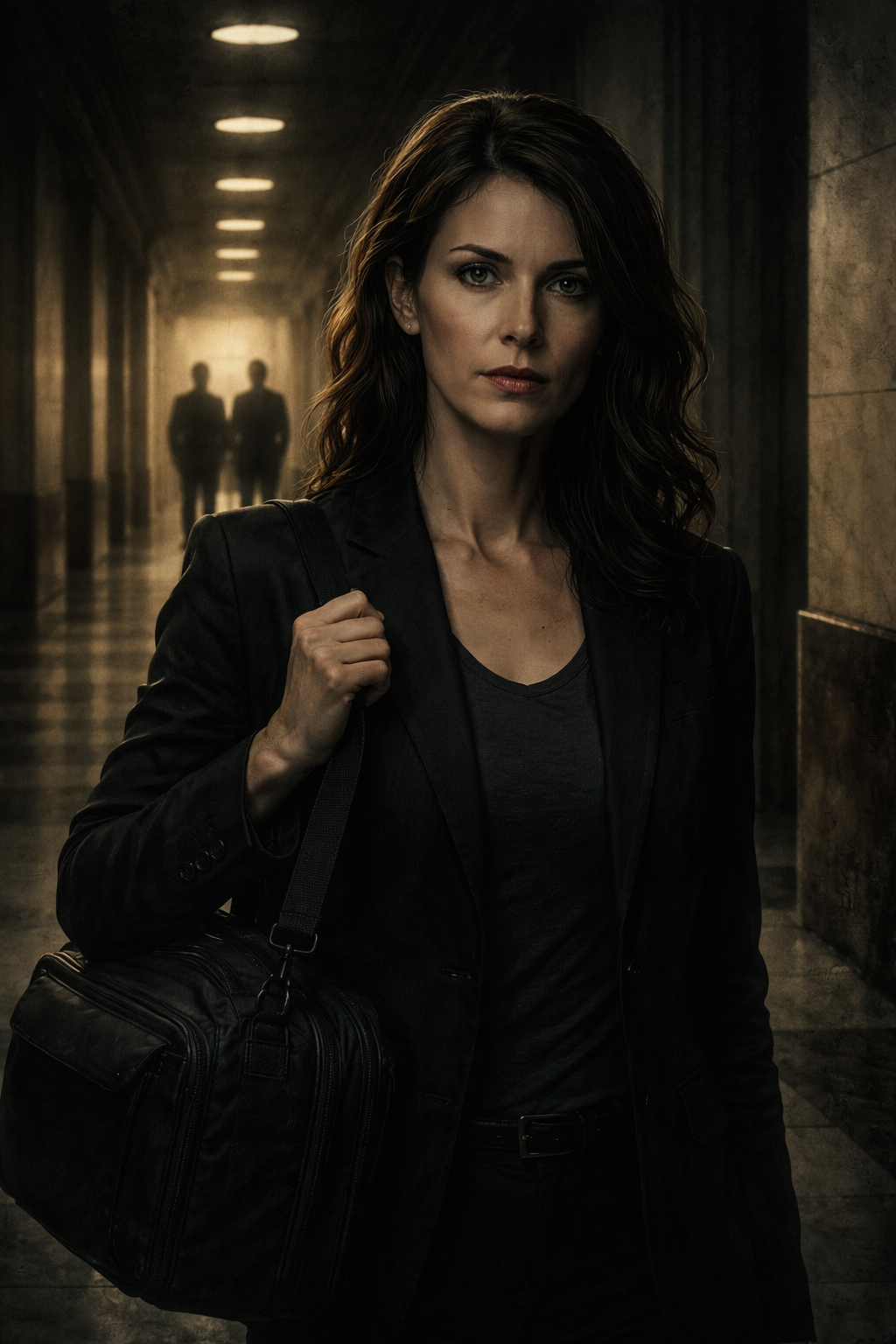
The Quiet Witness
Lena has spent twelve years making herself invisible. As a court stenographer, she is furniture — present for everything, noticed by no one. But when she is assigned to a closed, unnumbered hearing on an unremarkable Tuesday, she transcribes something she was never supposed to hear: a dying man's testimony linking the city's most powerful law enforcement official to the disappearance of a child.
Lena was a court stenographer who had transcribed ten thousand words a day for twelve years.
She was invisible by profession — a pair of hands, a machine, a woman no one looked at twice.
On a Tuesday in October she was assigned to a closed hearing she had not been briefed on.
The case had no number she recognized, no plaintiff name, just a grey folder marked "Procedural."
The judge entered without his clerk, which had never happened in her twelve years of service.
Three men in identical dark suits sat across from a fourth man who was shaking visibly.
Nobody introduced themselves, nobody acknowledged Lena, nobody looked at her even once.
The fourth man spoke in fragments — names, coordinates, dates — his voice barely above a breath.
Lena's fingers moved automatically, the words flowing through her hands into the machine.
Then the fourth man said a name that made the judge's hand close slowly into a fist.
It was the name of the city's police commissioner, followed by the word "ordered." Followed by a date.
Followed by the name of a fourteen-year-old boy who had disappeared in 2019.
The three suited men went very still in a way that felt practiced and deliberate and cold.
The judge recessed the hearing for fifteen minutes without explanation or eye contact.
Lena sat alone in the room with her machine and did not move and did not breathe loudly.
When no one returned after five minutes she looked down at her transcript without meaning to.
The fourth man was still in his chair, head bowed, hands flat on the table, unmoving.
She said excuse me softly and he didn't respond and she realized he was unconscious or worse.
She hit the emergency call button by the door and then stood very still, thinking hard and fast.
The transcript was in her machine. The machine was in her bag. Her bag was on her shoulder.
She walked out of the courthouse at a normal pace, nodding to the security guard by name.
The sky outside was white and cold and she did not run until she reached the parking garage.
She sat in her car with both hands on the wheel and thought about what she had just carried out.
Not a weapon, not money, not drugs — just words, just a transcript, just twelve lines of text.
But those twelve lines had the name of a powerful man attached to the death of a child. Her phone buzzed.
Unknown number. She let it ring and watched it with steady, careful eyes. It buzzed again.
Then a text appeared: "You forgot your scarf, Ms. Lena. Please come back." She had not worn a scarf that morning.
She started the car and drove without destination, just movement, just distance, just away.
In her bag, the machine hummed faintly against her side like a small, dangerous heart.